.png)


SHOKUDŌ: “But He’s Happy, Right?” From a Banking Job to Japanese Comfort Food in London

Updated: 5 days ago

When Christine told her parents that her husband was leaving a thirteen-year career in banking to cook for a living, she braced herself for the question about money.
“But he’s happy, right? It’s important to be happy.” That was what my dad said. It still makes me water up every time I think about it.
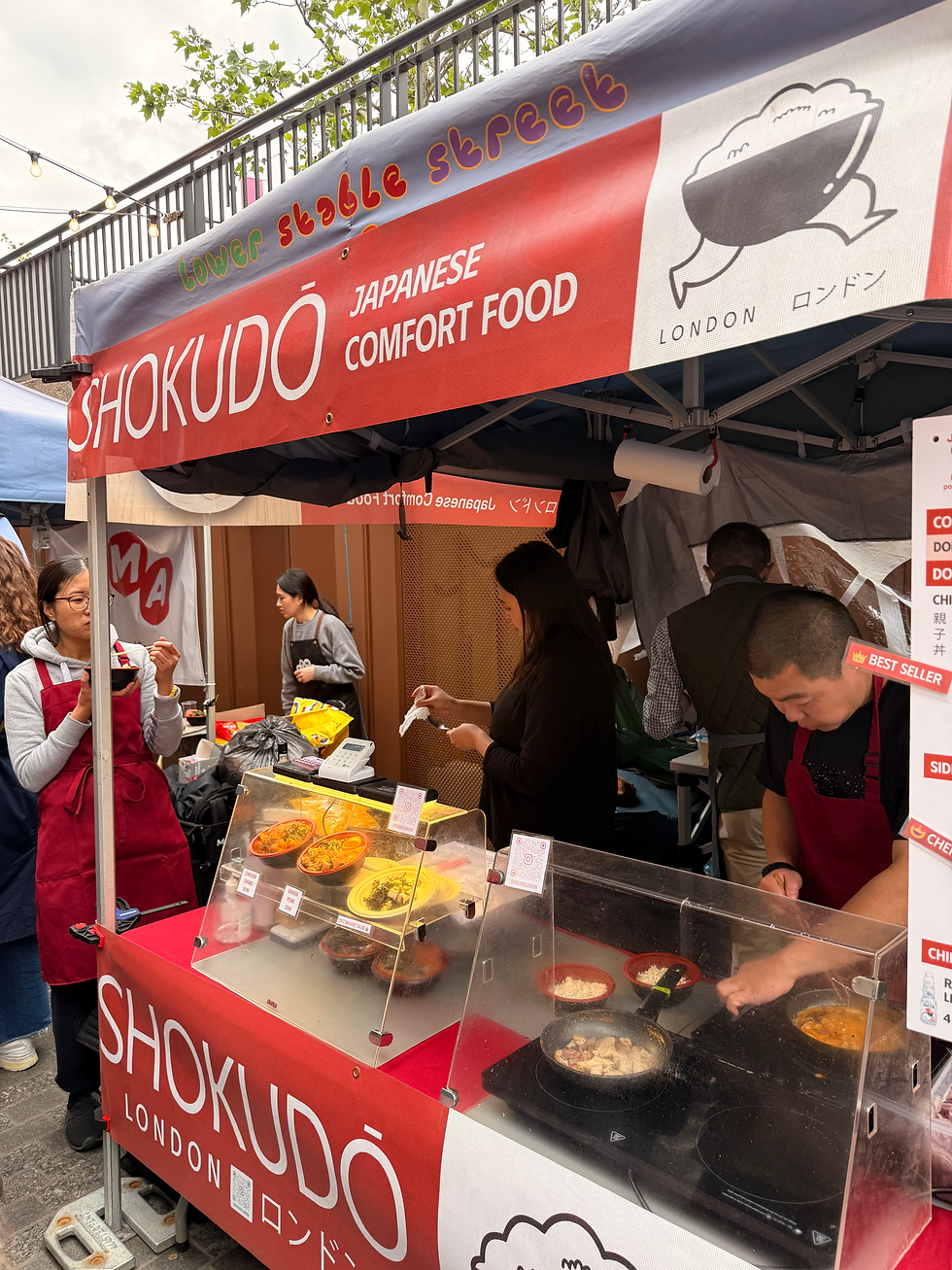
That was the end of 2023. Today SHOKUDŌ is Joe and Christine’s Japanese comfort food business in London, built around a small menu, a bowl of chicken and egg on rice, and a rule about never throwing anything away.
How they ended up in London
It was Joe’s job that brought them here. Born in Hong Kong, raised for years in Australia, the two of them had been back in Hong Kong for six years when a transfer opportunity came up for him, from the Hong Kong office to the London one. They took it.
“We had been in HK for six years by then and felt ready for a change,” Christine says.
The job that moved them across the world is the same one Joe would eventually walk out of. Thirteen years in banking, and he was burnt out. What made the decision real was not a bad week at work but a trip back to Australia to see family, and the arithmetic that trip forced on them.
The fact that we are so far away from our family, we can’t be unhappy where we live.
That is Christine, and she was the one who said it out loud first. She told him that if he was that unhappy, he should go and do something else. Two and a half years later she still has her own day job, looking after products at a tech scale-up, and runs the business side of SHOKUDŌ around it. Joe does it full time.
Why oyakodon, and why a menu this small
Joe has been cooking since he was six or seven. Not in a professional way, just relentlessly curious about ingredients, flavours and textures, and never able to leave an unfamiliar one alone. Oyakodon, the bowl of chicken and egg simmered together over rice, is one of his favourite things to eat. It is also, as Christine puts it, “so rarely done well in the market,” which is a polite way of saying they spotted a gap.
He is straightforward about why it belongs on the menu. “It’s everywhere in Japan, but it’s so unknown here,” he says. “It’s just the definition of comfort.” When someone new turns up not knowing what to order, this is what he sends out.
食堂 means canteen, and the name was chosen partly for the room it gives him. Everything on the menu is something he actually wants to eat, and the name does not lock him into any one thing. What it does not give him is permission to sprawl.

I’m always someone that goes really deep into something, so I don’t have a really big menu. In Japan, there’s one store that does just one thing. And I love that idea.

You can see it in the eggs. He buys from different farms and tests them against different dishes, on the basis that the right egg for one thing is not the right egg for another. The tamagoyaki, a rolled omelette that looks like the simplest item on any Japanese menu, took a long time. “All you can do is practice and practice and practice,” he says, until it becomes second nature. He is candid that he is not there yet with everything: “Yeah, I’m still learning.”
The rule about not wasting anything
The kitchen runs on mottainai, the Japanese idea of respect for resources and a dislike of waste, and on a philosophy Joe picked up from a very un-Japanese source. St. JOHN, the London restaurant that made nose-to-tail eating its whole argument, is where he takes his lead.
We believe that life is precious. When an animal has to sacrifice for our enjoyment, our fulfilment, then we should use the whole animal.
In practice that means chicken skin gets crisped and used rather than binned, and that ox tongue, a cut most kitchens discard, turns up as a special and on the supper club menu, slow-cooked with lotus root and a sweet soy glaze.
The ox tongue is also the most personal thing he makes. He first ate it in Hong Kong, at a tiny restaurant he found while he was still working there.
When I had it, my mind was blown. That restaurant is sadly now closed, and I think it still resonates with me.
He has kept making it since. It takes hours, and most people who order it have never had it before, which is the part he likes. “When I can introduce something that most people haven’t had before, I get really excited, because it’s personal to me.”

What a full room sounds like
Ask them how they know a service has gone well and neither of them mentions numbers.
Sometimes when we serve our food, the room just goes quiet. And you know that you’ve nailed something. That silence, that validation, is so impactful.
It is not what Joe expected to be measuring his life by after thirteen years in a bank, and the money is nowhere near what it was. He is unbothered. The work is physically much harder, and he does not experience it as work.
What they want next is not a restaurant. In three years, they would like both of them doing this full-time rather than just Joe. SHOKUDŌ has grown from a micro business into a small one supplying other businesses and a team of its own. Christine describes the goal as “a happy workplace where our team takes pride in what we do.”
Her father would recognise the word.
Have you had an oyakodon that stopped you talking? Tell us below 👇
🎥 Check our interview video below
Find Them
📍 Pop-ups, markets and supper clubs across central London (check Instagram for the next date)
🕢 Supper clubs from 6 pm
Enjoyed this? Check out More ESEA food → and this month’s events →
Enjoyed this? Check out More ESEA food → and this month's events →
You Might Also Like
Ong Lai Kopitiam: The Malaysian Kopitiam Robert Ngo Rebuilt in Canary Wharf, From the Green Tiles to His Mum's Wontons — The Malaysian kopitiam Robert Ngo rebuilt in Canary Wharf.
Urban Garden Fair: The East Asian Market in London Two Friends Built from Nothing — The East Asian market two friends built from nothing.
Wine The Noodles: Red Wine, Beef Noodles, and the Side of Taiwanese Food London Hasn't Seen — Red wine, beef noodles and a side of Taiwanese food London hasn't seen.
Mid-Autumn Festival London 2026: Dates, Events & Where to Buy Mooncakes — Every Mid-Autumn event in London, plus where to buy mooncakes and what the festival means.
Japanese Women Photographers: From 1950s to Now — What to See at The Photographers' Gallery Before It Closes — Twenty-seven women written out of Japanese photography, back at The Photographers' Gallery.

Comments