.png)


How Hong Kong Film Festival UK Became a Year-Round Home for ESEA Audiences


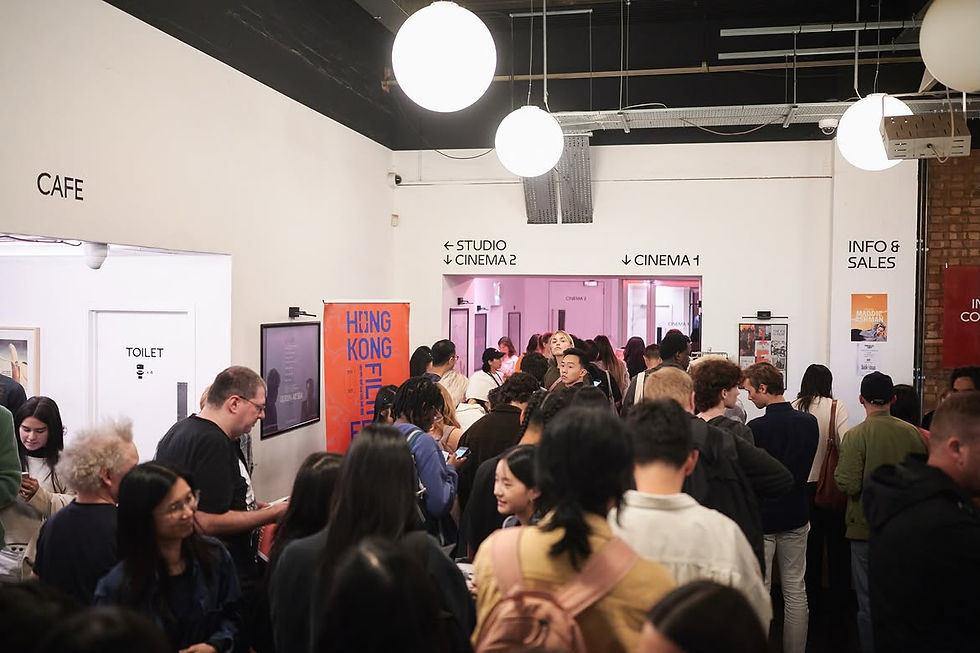
A few years ago, after one of Hong Kong Film Festival UK's screenings, a woman walked up to Ching Wong. She had moved from Hong Kong a few months earlier. Until that evening, she had barely left her home.
“She said she had arrived in the UK a few months before, but this was her first time really getting out of her house to be in a social occasion, because she was scared, she was feeling very unsettled. But this experience was very important for her. She felt safe and connected here.”
Ching is the festival's co-founder and its festival and programming director. She moved to London from Hong Kong herself, and she didn't need the feeling explained to her.
“I felt very moved, because I can share these difficult feelings of new migrants. I'm very happy that our screening can build this space where she felt she can connect with other people.”
We met Ching at the Barbican on 25 September, a few hours before the festival's fourth edition opened. When we asked for the moment that made her think “this is why we do it”, she had two.

A Hong Kong film on a boat
The second story is lighter. In September 2025, the festival took Johnnie To's The Heroic Trio (1993), with Michelle Yeoh, Anita Mui and Maggie Cheung as three superheroines, on to Theatreship, a floating arts centre in a historic cargo ship moored at Canary Wharf.
A woman from a Greek background found Ching afterwards.
“She came to me saying this was her first time watching a Hong Kong movie, and the first time watching a movie on a boat. For her it was quite mind-blowing.”
Two first times, from two very different people. One had grown up with this cinema and was a long way from it. The other had never seen it at all. Both ended up in the same kind of room, which is the festival's whole idea.

How Hong Kong Film Festival UK started
Around five years ago, filmmaker Ng Ka-leung invited Ching for a coffee at a café in East London. Both had recently arrived from Hong Kong, at a time when many others were making the same move.
“We had just migrated to the UK from Hong Kong, just landed here. We thought it would be great to show the films from Hong Kong, especially independent films, which are rarely seen and presented in the UK.”
The first edition ran in March 2022, in London, Manchester, Bristol and Edinburgh. From the start they also wanted room for Taiwanese and Korean films, for what Ching calls “the radical perspectives, the alternative storytelling” that rarely reaches UK screens.

Hong Kong and ESEA cinema, side by side
Four editions in, the programme reaches from Malaysia to Korea and Japan, and even to India. The festival often pairs a Hong Kong film with one from elsewhere in East and Southeast Asia, so audiences watch two histories next to each other.
“It's to show our shared experiences and histories, but at the same time our differences. It's good to see each other.”
This year's opening film pushes that outward again. Palimpsest: The Story of a Name follows Hong Kong-born editor Mary Stephen, who spent decades cutting Éric Rohmer's films, as she tries to find out why her Chinese family carries an English surname. Her own life went from Hong Kong to Montreal to Paris. Ching sees in it a kind of migration that is increasingly common: people who move more than once, and who get to decide what their identity is made of.
What “diaspora as agency” means
This year's theme sounds like a line from a funding application, so we asked Ching to explain it as if to a neighbour who had never seen a Hong Kong film.
She started with how diaspora usually gets talked about, as something passive that happens to you.
“We are forced to [be] displaced, or we couldn't use our own language anymore.”
Add the anti-migrant climate in the UK and elsewhere, and that's most of the conversation. Then she turned it round, and the same movement became the point.
“We move between languages, we move between cultures, and we have more freedom somehow to invent ourselves, or to start a dialogue with other cultures.”
In practice that means three things for the festival. Hongkongers behind the camera, telling their own stories. Those stories on screen, where audiences can recognise themselves. And communities talking to each other, Hong Kong with the wider ESEA diaspora in Britain.
Sitting in that room for a couple of hours does something reading about it doesn't. You watch a story from another angle, with people who have their own versions of it, and for once your perspective is the one on the screen.

Why HKFFUK is going year-round
For three years, the festival came and went in one short burst a year. Audiences noticed.
“In past editions, many audiences asked: other than the ten days of the main festival, where are you? Have you disappeared?”
So this year it becomes a year-round festival, with seasons running through autumn, winter and spring. Ching was clear about why winter matters.
“Winter is especially a difficult season for everybody in the UK.”
For someone who arrived a few months ago and hasn't left the house much, a screening in January might be the reason to go out.
After we finished filming, the team were still busy around the Barbican, getting everything ready for opening night. Four editions on from that coffee in East London, they were still at it. We left them to it, grateful that someone had kept this room open.
Have you been to a Hong Kong Film Festival UK screening, or is there a Hong Kong film you'd send a friend to first? Tell us below 👇
🎥 Check our interview video below
Find Them
📍 Screenings across London venues, including the Barbican, ICA, Rio Cinema, Close-up Cinema and Theatreship
🕣 2026 festival runs 25 September to 4 October, then continues with autumn, winter and spring seasons
Enjoyed this? Check out this month's events →
You Might Also Like
Beyond War Stories: Star Nhà Ease Returns to Reframe Vietnamese Cinema — The film season changing how UK audiences see Vietnamese cinema.
Muri: The Filipino Violinist-Singer Who Found Her Solo Sound Between Manila, Paris and London — Three cities, two instruments and one voice of her own.
Chiharu Shiota & Yin Xiuzhen at Southbank Centre: Threads, Suitcases & the Things We Carry — Two artists on memory, migration and what we bring with us.
Ong Lai Kopitiam: The Malaysian Kopitiam Robert Ngo Rebuilt in Canary Wharf, From the Green Tiles to His Mum's Wontons — A Malaysian kopitiam in Canary Wharf, built on his mum's wontons.
Meet Cantoast Bakery: Hong Kong Style French Toast — Hong Kong-style French toast that will ruin all other toast for you.


Comments